Game Economy Is Experience Design
Game economy design shapes the experience of earning, waiting, choosing, and improving. In a competitive MOBA, upgrade costs and unlock timing affect both the player making the choice and the opponent they face.
A game economist designs the experience of earning, waiting, choosing, and improving. On a competitive MOBA project, a question as simple as “When should players unlock their next hero?” turned into a question about what we wanted a player to feel at that moment. An early unlock could give them a reason to experiment, or overwhelm them before they understood their first hero. A late unlock could feel earned, or make the game feel repetitive. The right answer depended on what had happened in the matches leading up to it.
Start with the moment you want to create
Suppose the goal of a second hero unlock is to give players a fresh tactical choice. Look for the moment when they have enough experience to understand how the second hero plays differently. Too early, and they may pick based on the portrait alone. Too late, and they may already have formed the impression that every match feels the same. That gives the economy designer a concrete question to bring to the game designer: what should someone understand about combat before this choice appears?
That conversation determines what to test. Compare first use of the new hero, how often players return to it, and what players say they were trying to accomplish when they picked it. An unlock can be claimed immediately and still fail to produce the moment of discovery it was meant to create.
Give each type of progression a purpose
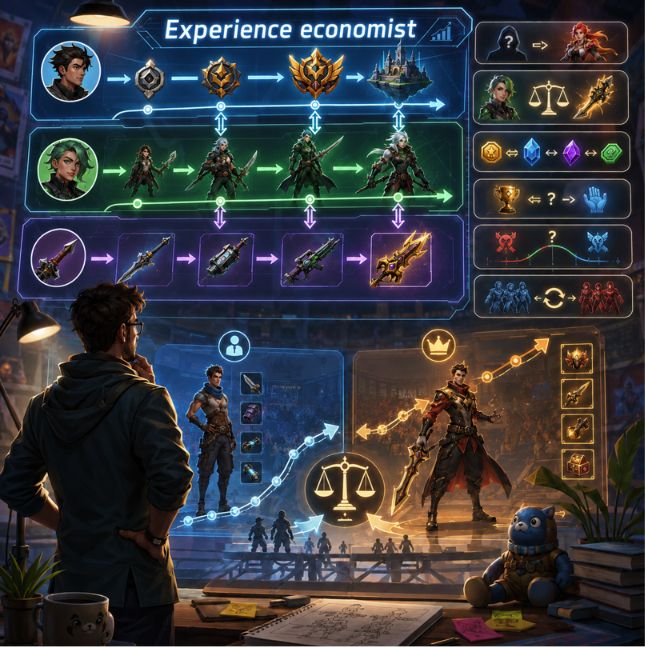
In a competitive MOBA, a player profile, a hero, and a piece of equipment can all progress at different speeds. Tune them according to what each is supposed to offer. The player profile can provide a sense of momentum across matches. Hero progression can reward staying with a character long enough to understand its strengths. Equipment can create a decision about which tools to bring into a fight. If every layer hands out power at the same pace, players can move quickly through the numbers while running out of meaningful things to learn.
- Player profile — A sense that time invested across matches adds up.
- Hero mastery — The satisfaction of understanding a particular character and playing it better.
- Equipment — A tactical choice about what to bring into the next matchup.
Consider an upgrade that trades burst damage for survivability. The cost can make the player consider whether it suits their hero and the matchups they face. If the upgrade dominates almost every alternative, the same cost becomes a compulsory wait. Before changing the price, look at when players choose the upgrade and whether there is any credible reason to choose something else.
Reward participation and achievement separately
A loss can teach a player something and still feel like wasted time if it leaves them no closer to a goal. Participation rewards can keep a losing player moving toward an unlock. A distinct win reward or mastery milestone can give success recognition of its own. The design question is how to make progress possible on a difficult evening while keeping a hard-fought win meaningful.
Test the reward schedule over a run of matches. Look at return rates after loss streaks and ask players whether the rewards made them want to improve, experiment with a different build, or simply complete the required number of matches. These responses distinguish a reward that supports play from one that turns play into a chore.
Design for the opponent’s experience too
Matchmaking determines who meets whom. The economy determines what each person brings to that match. Two players can have comparable skill and still face a very different contest if one has reached a powerful upgrade much earlier. A price change that makes that upgrade more common can therefore change perceived difficulty across the entire matchmaking bracket.
The same applies to monetization. If a purchase accelerates access to an upgrade, examine which opponents the purchaser will face while that advantage matters. A purchase that opens more viable builds can feel valuable to the buyer. In a competitive match, the opponent should also have a credible way to respond. Compare match outcomes by skill and loadout, then ask both sides which decisions they felt could have changed the result.
How I would review an economy change
Bring one proposed change to the game designer and describe the match or unlock it should improve, whose experience changes, and what would make that change worth keeping. For a cheaper equipment upgrade, for example, the hypothesis could be that more players experiment with a second build without concentrating wins around a single loadout. Examine build diversity and match outcomes by skill bracket, then use playtests to find out whether players understood their options. If one build crowds out the others, the next conversation is about the tactical trade-off the upgrade creates.
Playtest the wait between two unlocks
An economy spreadsheet can estimate that a new player will earn the next hero after eight matches. A playtest can show what those eight matches feel like. Ask players after each session what they are working toward, whether they can see a path to it, and what they expect to do differently when they get there. A visible goal can make a wait feel purposeful. An opaque goal can make the same wait feel like a stall.
Then observe the first match after the unlock. If players immediately switch back to their starter hero, find out whether they understood the new role, could try it in a low-pressure setting, and had a reason to bring it into a real match. Giving the hero earlier will not fix an unreadable ability or a punishing first matchup. This is where economy design and game design have to work on the same problem.
That is why I think of the role as an experience economist. A spreadsheet can tell you how long it takes to unlock something. The job is to decide what makes it worth waiting for, what the player can do with it, and how that changes the game for everyone in the match.